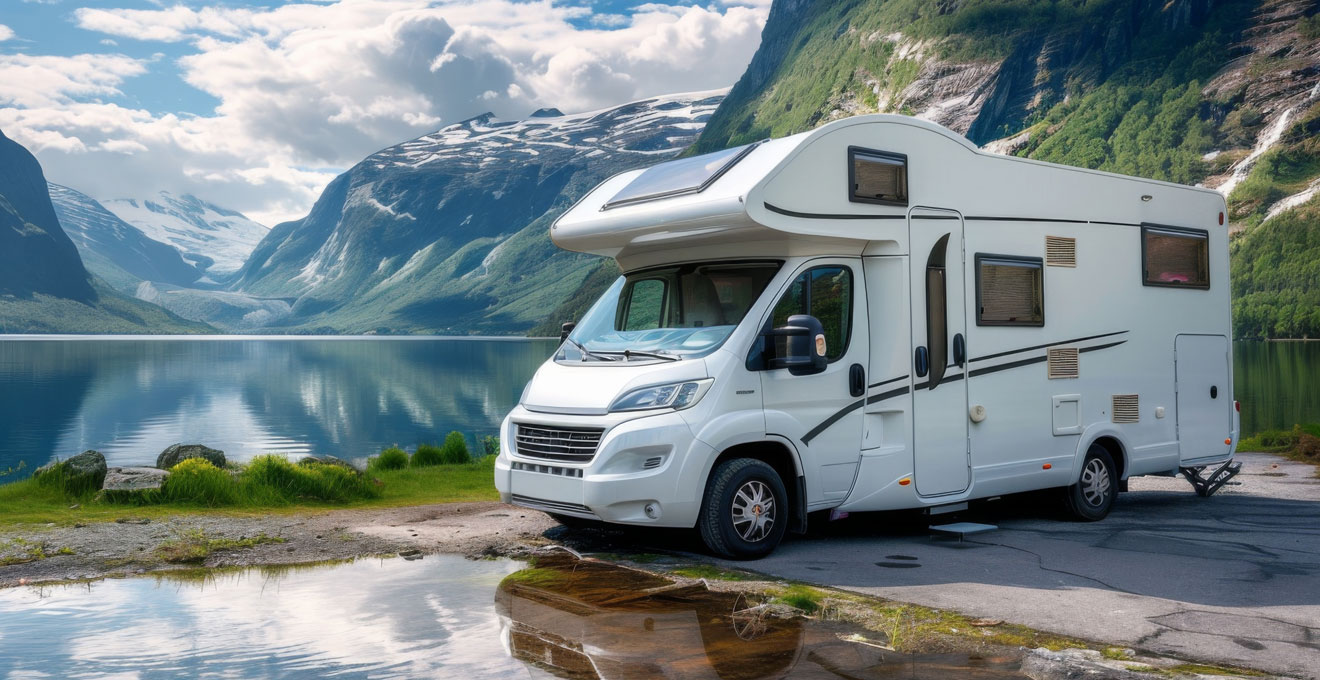
The labels sound interchangeable until you arrive at the depot and realise one vehicle contains a fitted kitchen whilst the other is essentially a passenger shuttle. That distinction shapes every decision from wild camping legality to daily running costs, yet most first-time hirers focus exclusively on group size when choosing between a campervan or minibus.
Rental trends in 2026 reveal a persistent mismatch: families booking campervans for motorway-to-campsite trips where a minibus would suffice, whilst couples squeeze into minibuses then discover they lack facilities for the spontaneous Highland detours they’d planned. The vehicle category matters less than whether its design philosophy aligns with your actual travel style.
This mismatch stems from treating the decision as a simple capacity calculation. Rental platforms default to passenger headcount filters, which directs a family of four towards any vehicle with four seats. What those filters ignore: whether you’ll cook breakfast inside the vehicle or walk to campsite facilities, whether you’ll move location when weather shifts or stay anchored to pre-booked pitches, whether your route passes through areas with abundant campsites or remote regions where accommodation options thin out dramatically.
Understanding the structural difference between these vehicle types transforms an overwhelming feature comparison into a straightforward question: does your trip require integrated living facilities, or just reliable transport between accommodation points? That distinction determines which compromises you’ll accept and which features justify premium costs.
Your vehicle match in three questions
- Group reality check: Actual sleeping vs travelling numbers (4 adults sleeping ≠ 4 adults comfortable for 10 days)
- Trip spontaneity level: Pre-booked campsites favour either option; wild camping requires campervan facilities
- Total cost calculation: Campervan premium vs minibus + camping gear + campsite fees
The challenge most hirers face isn’t identifying their ideal vehicle — it’s recognising which trip characteristics actually matter for that selection. Surface-level preferences (‘I like the idea of wild camping’) prove unreliable predictors compared to operational realities (‘I’m travelling in February through the Scottish Highlands, where campsite facilities close seasonally’).
This article walks through the decision framework that rental industry veterans apply when advising confused customers at the booking stage. Rather than exhaustive feature lists, you’ll find filtering questions that eliminate unsuitable options quickly, followed by practical considerations that prevent costly booking mistakes.
Two distinct travel philosophies
Both vehicles share the ‘van’ silhouette, which explains the confusion. Strip away that superficial similarity and you’re comparing a mobile hotel room against a passenger vehicle that happens to have space for your tent in the back.
A campervan integrates sleeping berths, cooking facilities, storage, and climate control into a single self-contained package. This conversion transforms the vehicle into a mobile hotel room, allowing you to wake up at a Highland loch with a functioning kitchen just steps away. For those looking to explore the European continent, securing a campervan hire at Paris-Charles de Gaulle serves as the perfect strategic starting point. By picking up a vehicle directly at France’s primary international hub, travellers bypass city traffic and gain immediate access to the diverse road networks of Western Europe.
This design prioritises autonomy. Campervans deliver accommodation and transport simultaneously, which fundamentally alters where and how you can travel. Wild camping becomes viable because your facilities travel with you. Motorway service stops transform into legitimate overnight options (where legally permitted). Route changes require no advance campsite rebooking.
Minibuses serve the opposite philosophy: optimised passenger transport with generous luggage capacity. The interior remains fundamentally a seating area. Sleeping requires either reclining seats (uncomfortable beyond a single emergency night) or pitching separate camping equipment at your destination. This approach separates transport from accommodation, creating dependency on campsites, hotels, or pre-arranged lodging. The upside? Lower hire costs, superior fuel economy, and flexibility to combine vehicle travel with varied accommodation types. Families planning structured itineraries with pre-booked campsites often find minibuses deliver everything needed without paying for integrated facilities they won’t fully utilise.
The choice isn’t about which vehicle is ‘better’ — it’s about which design philosophy matches your planned travel pattern. Get this alignment wrong and you’ll either pay for unused campervan features or face logistical headaches when your minibus lacks facilities your itinerary assumes.
Choosing your vehicle: matching priorities to reality
Most comparison guides drown readers in feature checklists without explaining when those features actually matter. Three filtering questions eliminate most of the decision complexity by addressing your trip’s structural realities rather than abstract preferences.
-
How many people will sleep in the vehicle each night?
1-2 travellers: 2-berth campervans for autonomy, or minibuses if using campsites with cabin accommodation
3-4 travellers: 4-5 berth campervans where integrated facilities justify investment
5+ travellers: Minibus with tent setup, or split into two smaller campervans
-
Will you wild camp or use campsites primarily?
Wild camping focus (Scotland): Campervan essential — self-contained facilities required under access codes
Campsites with facilities: Either option viable; choose based on budget and autonomy preferences
Mixed approach: Campervan provides flexibility to adapt as conditions dictate
-
What’s your priority: spontaneity or budget optimisation?
Spontaneity/comfort priority: Campervan premium justified by route flexibility and accommodation independence
Budget-conscious: Minibus if campsite infrastructure and advance planning are acceptable
Consider a couple planning a 10-day Scottish Highlands loop in September. Initially attracted to minibus cost savings, they reconsidered after mapping remote Highland locations with limited campsite facilities. A campervan’s higher hire rate became cost-neutral after several days whilst providing weather-independent accommodation when conditions deteriorated. The autonomy premium justified itself when their planned Skye campsite filled unexpectedly — they simply relocated to a coastal layby for the night. This scenario illustrates how operational realities often override initial cost comparisons.
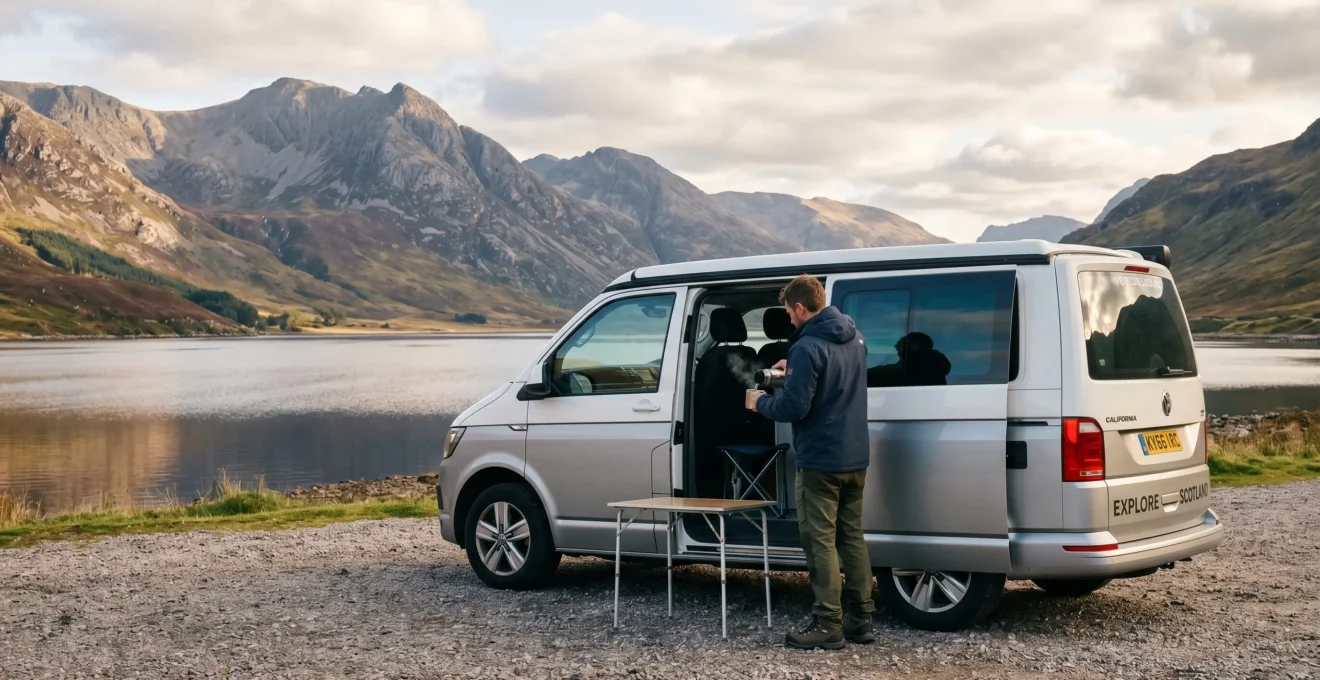
The campervan proposition: autonomy at a premium
Campervans suit travellers who value accommodation independence over cost minimisation. The ideal profile: couples or small groups (2-4 people) planning routes through areas with limited campsite infrastructure, or those who resent the rigidity of pre-booked accommodation.
Industry practice shows campervan hirers skew towards spontaneous itinerary changes. The wild camping guidance published by VisitScotland confirms that Scotland‘s Land Reform Act 2003 permits camping on most unenclosed land, provided travellers follow leave-no-trace principles. This legal framework transforms campervans into genuine exploration tools — your accommodation moves with you rather than anchoring you to fixed locations.
Campervans typically cost notably more per day than equivalent minibuses. That premium buys integrated cooking facilities (eliminating campsite meal dependency), onboard toilet/shower units (critical when wild camping or travelling with young children), and climate control systems that function independently of external hookups.
The minibus alternative: flexibility on a budget
Minibuses excel when your trip structure involves pre-planned accommodation or when group size exceeds comfortable campervan capacity. The sweet spot: families or friendship groups (5-8 people) following established routes with confirmed campsite bookings.
Rental data suggests minibuses achieve superior fuel economy compared to campervans, a difference that compounds over long distances. Lower insurance premiums and reduced daily hire rates create meaningful savings. For a fortnight’s hire, the total cost difference can be substantial before factoring accommodation expenses.
The trade-off surfaces when infrastructure fails you. Campsite fully booked due to a local festival you didn’t research? Your minibus offers no backup accommodation option. Unexpected rain turns tent pitching into a miserable ordeal? Minibuses reward meticulous planning and tolerate less spontaneity.
Hybrid scenarios worth considering
Standard advice oversimplifies: solo travellers can benefit enormously from campervans despite ‘inefficient’ single occupancy, particularly those working remotely who need functional living space beyond mere sleeping berths. The onboard table, heating, and kitchen facilities create a mobile office that justifies the cost for extended trips.
Conversely, six-person groups often fare better splitting into two compact campervans rather than cramming into a single large minibus. Relationship dynamics matter — extended families may value the privacy of separate sleeping units. Seasonal factors shift calculations too: winter Highland trips demand campervan heating systems that minibus-tent combinations cannot match, whilst summer coastal routes with abundant campsites neutralise campervans’ infrastructure independence advantage.
Practical considerations before booking
Vehicle choice resolved, five operational details determine whether your hire proceeds smoothly or derails before you’ve left the depot. Each represents a common booking blocker that catches unprepared hirers.
Licence requirements prove less restrictive than many assume. As the official licence categories detailed by the DVLA on GOV.UK clarify, a standard UK Category B driving licence covers vehicles up to 3,500kg MAM (Maximum Authorised Mass). Most campervans fall comfortably within this threshold, as do all minibuses designed for 8-9 passenger capacity. The C1 category only becomes necessary for larger motorhomes between 3.5 and 7.5 tonnes. International licence holders should verify DVLA equivalency before assuming compatibility.

-
Driving licence validity: UK Category B covers vehicles up to 3,500kg (most campervans and all minibuses)
-
Insurance excess level: Typically higher for campervans than minibuses; investigate excess reduction options and their cost-benefit ratio
-
Mileage allowance: Compare daily/weekly limits against unlimited options; calculate your planned route distance
-
Pickup/drop-off locations: Airport depots prioritise convenience; city locations often reduce costs; verify one-way hire fees if returning to different location
-
Cancellation policy: Free changes window varies by provider; assess value against trip uncertainty
-
Additional driver costs: If sharing driving responsibilities, verify insurance coverage extension and any supplementary fees
Depot location shapes trip logistics more than hirers anticipate. Airport pickups trade premium costs for arrival-day convenience, whilst city depots reward those willing to navigate public transport with lower rates. One-way hires incur supplementary fees that can be substantial, making circular routes economically preferable where itineraries allow.
Payment structures have evolved beyond single upfront transactions. Leading providers now facilitate instalment plans for larger bookings, easing cash flow constraints for longer hires. Cancellation terms merit scrutiny — flexible policies permit free changes within specified windows, valuable protection when trip dates remain uncertain. For travellers who prefer guided support over DIY logistics, understanding the advantages of a travel agency can reveal when packaged solutions outweigh independent vehicle rental, particularly for complex multi-country itineraries or first-time road trippers unfamiliar with UK driving conditions.
Your questions answered
Can you sleep in a minibus or do you need a separate tent?
Standard minibuses are designed for passenger transport, not sleeping. While you could recline seats for emergency overnight stops, you’ll lack flat sleeping surfaces, insulation, blackout capabilities, and climate control. Most minibus hirers use campsites with tent or cabin accommodation. Campervans provide purpose-built sleeping berths with mattresses, blackout blinds, heating, and proper ventilation.
Do I need a special driving licence to hire a campervan in the UK?
Most campervans fall under 3,500kg gross vehicle weight, covered by a standard UK Category B driving licence. Only larger motorhomes exceeding 3.5 tonnes require a Category C1 licence. According to GOV.UK motorhome driving guidance, this threshold captures the vast majority of rental fleet vehicles. Verify the specific vehicle weight with your rental provider before booking.
How far in advance should I book for summer travel?
For July-August peak season, booking well in advance is advisable for popular campervan models, as availability tightens considerably for premium vehicles and specific pickup locations. Last-minute availability exists but severely limits choice. Minibuses generally maintain better short-notice availability due to larger fleet numbers. Shoulder season travel (May-June, September) permits shorter booking windows. Beyond vehicle hire, factor in broader trip planning timelines — time to prepare a trip varies depending on itinerary complexity and seasonal ferry bookings if travelling beyond Britain.
What’s the real cost difference beyond the daily hire rate?
Campervans typically cost notably more per day than comparable minibuses. Total trip cost depends on fuel economy (minibuses generally more efficient), campsite pitch fees (potentially avoidable with campervan wild camping), insurance excess levels (higher for campervans), and equipment hire (minibuses require separate tent and cooking gear). Calculate your specific scenario across the full trip duration rather than comparing hire rates in isolation — a campervan’s premium can be offset by campsite savings over extended wild camping periods.
Vehicle specifications fade in importance once you’ve honestly assessed how much advance planning you’ll actually complete. Meticulous planners extract full value from minibus cost savings. Spontaneous travellers will curse every night they’re anchored to pre-booked accommodation. Match your planning habits to the vehicle’s design assumptions.